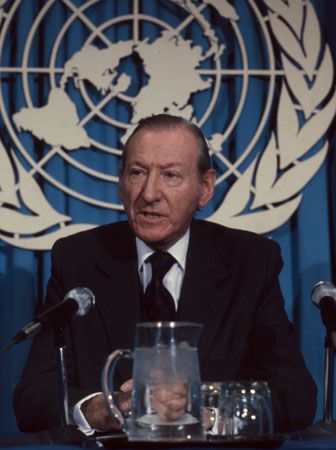
Unpacking the Shadows of History: Exploring the Waldheim Affäre
The annals of 20th-century political history are replete with controversies, but few have cast such a long and intricate shadow as the
Waldheim Affäre. This pivotal episode, which gripped Austria and the international community in the mid-1980s, centered on Kurt Waldheim, a former United Nations Secretary-General and a candidate for the Austrian presidency. What began as a routine political campaign rapidly spiraled into a profound reckoning with historical truth, national identity, and the lingering specter of World War II. It exposed uncomfortable truths about Austria's past, challenged perceptions of wartime neutrality, and ignited a fierce debate about accountability and collective memory. More than just a scandal involving an individual, the Waldheim Affäre became a crucible in which Austria was forced to confront aspects of its history it had long preferred to keep hidden.
The Man at the Center: Kurt Waldheim's Early Life and Career
Kurt Waldheim's public life before the controversy was one of immense prestige and achievement. Born in 1918 in Sankt Andrä-Wördern, Austria-Hungary, he came of age in a turbulent period between the two World Wars. He studied law at the University of Vienna and joined the Austrian diplomatic service shortly before the annexation of Austria by Nazi Germany in 1938. His wartime service, however, became the eye of the storm.
From 1942 to 1945, Waldheim served in the German Wehrmacht, primarily in the Balkans, holding the rank of Oberleutnant (First Lieutenant). He was an intelligence officer in Army Group E, which was responsible for brutal anti-partisan operations and reprisals against civilians in Yugoslavia and Greece. These units were also implicated in the deportation of Jewish communities, most notably from Salonika. After the war, Waldheim rapidly ascended the ranks of post-war Austrian diplomacy, serving as Austria's Permanent Observer to the UN, Foreign Minister, and ultimately, as the fourth Secretary-General of the United Nations from 1972 to 1981. His distinguished international career, marked by efforts towards global peace and conflict resolution, seemed to have completely eclipsed any questions about his wartime activities. He presented himself as a victim of Nazi aggression, a narrative that was widely accepted for decades.
The Unveiling of the Past: The Controversy Erupts
The
Waldheim Affäre erupted with full force during the 1986 Austrian presidential election campaign. Waldheim, a candidate for the conservative Austrian People's Party (ÖVP), was a strong contender. However, a series of investigative reports, spearheaded by journalists and particularly by the World Jewish Congress (WJC) under the leadership of Edgar Bronfman Sr., began to surface damning revelations about his wartime past.
The core of the allegations revolved around two main points:
- Active Participation in War Crimes: While there was no direct evidence that Waldheim personally committed atrocities, the WJC and other investigators provided documents suggesting his knowledge of, and complicity in, war crimes perpetrated by units he served with. This included intelligence gathering related to the brutal suppression of partisans and the deportation of Jews.
- Deliberate Omission and Misrepresentation: More damaging was the revelation that Waldheim had systematically omitted significant portions of his wartime service from his autobiographies and official biographies. He had consistently presented his service as brief and largely uneventful, glossing over his time in the Balkans and his promotions. His initial responses to the allegations were a mixture of denial, claims of memory lapses, and shifting explanations, which only intensified the scrutiny and fueled public suspicion. He infamously stated, "I only did my duty as a soldier," a phrase that resonated poorly given the context of Nazi atrocities.
The documents unearthed pointed to Waldheim's role in Army Group E, a unit notorious for its operations in the Balkans. Specific allegations included his involvement in intelligence analyses that facilitated the German reprisal actions against Yugoslav partisans and civilians, and his presence during the planning stages related to the deportation of the Jewish population of Salonika.
International Fallout and Domestic Division
Despite the escalating international outcry, Waldheim was elected President of Austria in June 1986. His victory, fueled by a narrative of national pride and defiance against perceived foreign interference, highlighted the deep divisions within Austrian society. While many Austrians rallied around him, viewing the criticism as an attack on their nation, others were deeply troubled by the revelations and the country's apparent unwillingness to confront its past.
The international reaction was swift and severe. Israel recalled its ambassador from Vienna. Even more significantly, in 1987, the United States Justice Department placed Waldheim on a "watch list" for undesirable aliens, effectively banning him from entering the U.S. This unprecedented move against a sitting head of state sent shockwaves through the diplomatic world and further isolated Austria on the international stage. Other nations reduced their diplomatic contacts, and Austria found itself in a state of diplomatic semi-isolation, often referred to as a "diplomatic ice age."
Domestically, the
Waldheim Affäre forced an agonizing, albeit necessary, public debate about Austria's role in World War II. For decades, Austria had largely perpetuated the "first victim" myth, portraying itself solely as a victim of Nazi Germany, thereby downplaying its own complicity and the enthusiastic support many Austrians gave to the Nazi regime. The Affäre shattered this comfortable narrative, compelling the nation to acknowledge its shared responsibility and the darker chapters of its history.
In an effort to provide an objective assessment, the Austrian government appointed an International Commission of Historians in 1987. Comprising distinguished historians from various countries, the commission was tasked with thoroughly investigating Waldheim's wartime activities.
The Commission's Findings and Enduring Legacy
The International Commission of Historians presented its report in February 1988. Their findings, while not directly accusing Waldheim of personally committing war crimes, were nevertheless damning. The commission concluded that:
- Waldheim was indeed aware of the atrocities being committed by his units in the Balkans.
- He was part of a system that perpetrated heinous crimes, even if his role was primarily intelligence-based rather than directly operational.
- He had deliberately obscured and misrepresented his wartime service, offering misleading statements about his presence at various locations and his responsibilities.
The commission's report confirmed that Waldheim had served as an intelligence officer involved in planning and evaluating military operations where war crimes were committed. While clearing him of direct guilt in committing specific crimes, it firmly established his knowledge of, and complicity in, the machinery of Nazi repression.
The immediate impact on Waldheim's presidency was significant; he remained largely a ceremonial figure during his single term, unable to travel to many Western countries. More profoundly, the Affäre served as a catalyst for Austria's belated and often painful process of
Vergangenheitsbewältigung – coming to terms with its past. It spurred a deeper public discourse about Austrian identity, the role of individual responsibility, and the imperative of historical truth.
Practical Insights for Historical Understanding:
- Scrutiny of Public Figures: The Waldheim Affäre underscores the importance of rigorous background checks and critical scrutiny of public figures, especially those seeking high office, to ensure transparency and accountability.
- The Power of Investigative Journalism: It highlights the crucial role of independent journalism and historical research in uncovering hidden truths, even in the face of political resistance.
- Collective Memory vs. Individual Responsibility: The case demonstrates the complex interplay between a nation's collective memory and the individual responsibilities of its citizens, especially in times of conflict. It shows how national narratives can sometimes obscure uncomfortable truths.
- Lessons in Transparency: For any nation, the Waldheim Affäre offers a stark lesson in the long-term repercussions of historical obfuscation and the ultimate necessity of confronting one's past honestly to move forward.
In the decades following the
Waldheim Affair, Austria has made significant strides in acknowledging its historical role during WWII. Memorials have been established, research has flourished, and educational initiatives have been launched to ensure that future generations understand the complexities of their nation's history. The Affäre thus stands as a powerful testament to the enduring quest for justice and the profound impact of historical truths on national and international relations.
In conclusion, the Waldheim Affäre was far more than a personal scandal; it was a profound historical earthquake that reshaped Austria's relationship with its past and its place in the world. It forced a nation to finally confront its complicity in the horrors of the Nazi era, dismantle cherished myths, and embark on a difficult journey of introspection and reconciliation. The legacy of Kurt Waldheim's contested past continues to serve as a potent reminder of the fragility of memory, the importance of historical accuracy, and the unwavering demand for accountability, even decades after the events themselves.